
What Are BioPROTACs?
A bioPROTAC is a genetically encoded protein that removes a specific target protein from inside a cell. It doesn't block the target's function. It marks the target for destruction, hijacking the disposal system the cell already runs (the ubiquitin-proteasome pathway) and pointing it at a protein it would otherwise leave alone.
The name borrows from PROTAC (proteolysis-targeting chimera), the small-molecule technology that turned targeted degradation into a field. The difference is what the molecule is made of. A PROTAC is synthesized chemistry. A bioPROTAC is a protein: designed, expressed, and delivered like any other biologic. That sounds like a technicality. It is the entire reason bioPROTACs reach targets small molecules physically cannot.
The Problem: Why Some Proteins Are "Undruggable"
Most drug discovery still depends on finding a pocket, a groove on a protein's surface that a small molecule can wedge into and block. It works well when a pocket exists. It doesn't work at all when one doesn't.
A large share of disease-relevant proteins have no such pocket. Scaffolding proteins, transcription factors, and many regulatory proteins interact with their partners across broad, shallow surfaces rather than deep binding sites. No pocket means no small molecule, which means the target gets labeled "undruggable" and, for decades, effectively shelved.
Worth being precise about what that label describes. Not the biology. The tooling. "Undruggable" has always meant "no pocket for the chemistry we happen to have."
Targeted protein degradation changes the question being asked. Instead of "can we block this protein's active site," it asks "can we get this protein tagged for destruction." The second question doesn't need a pocket. It needs a way to hold onto the target long enough to flag it for removal.
How BioPROTACs Work
The ubiquitin-proteasome system, briefly
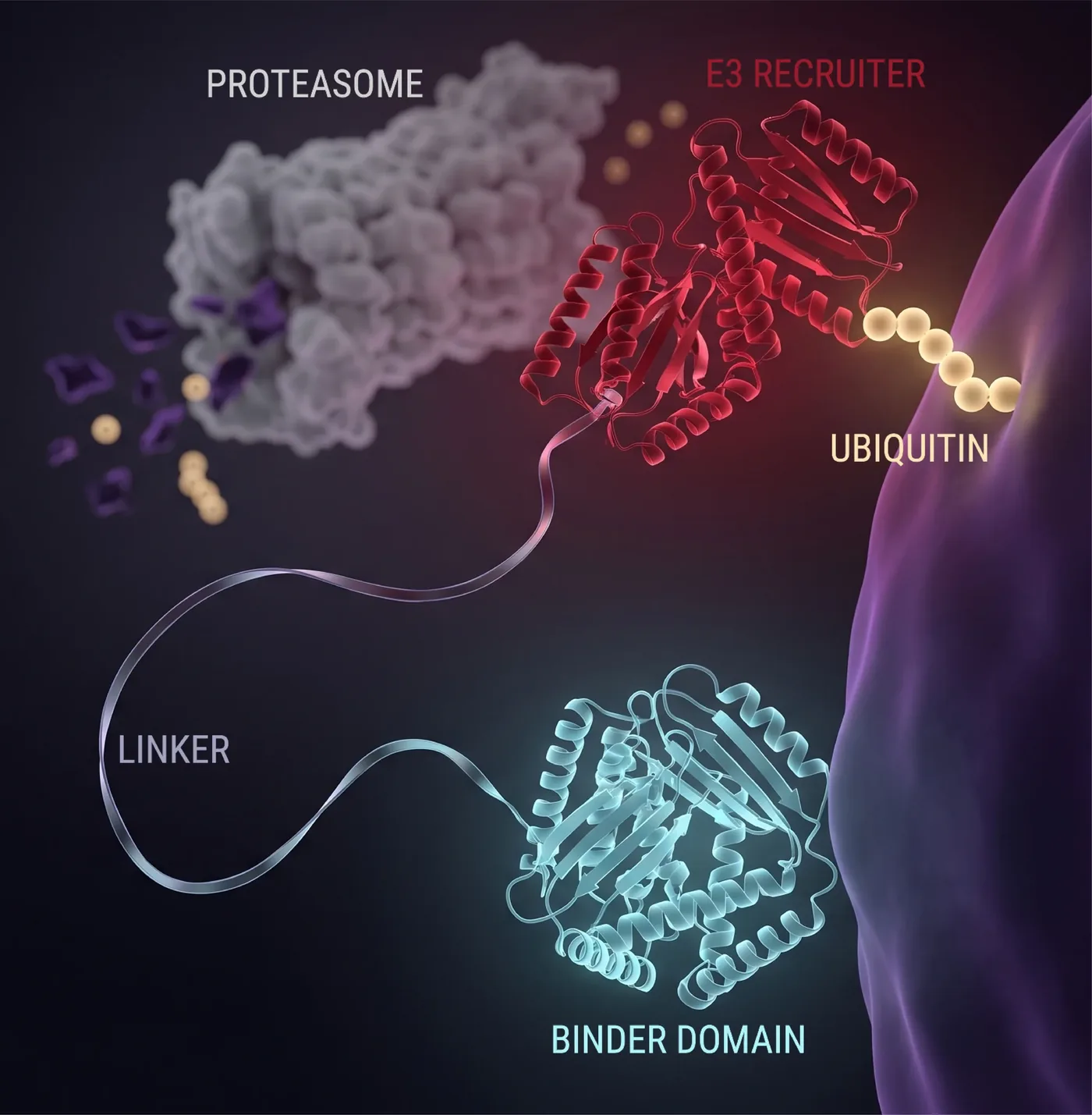
Every cell already runs a disposal pipeline. Proteins tagged with a small marker called ubiquitin get pulled into the proteasome and broken down. This happens constantly, to thousands of proteins, as routine cellular housekeeping. Targeted degradation doesn't invent a mechanism. It redirects an existing one toward a target protein that wouldn't normally be tagged.
Binder domains vs. small-molecule warheads
A conventional PROTAC uses two chemical "warheads" joined by a linker: one grabs the target protein, the other recruits an E3 ligase, the enzyme that attaches the ubiquitin tag. A bioPROTAC replaces the target-binding warhead with a genetically encoded binder domain (a DARPin, a nanobody, a miniprotein, or a peptide) fused directly to an E3 ligase or ligase-recruiting domain. Those binders engage broad protein surfaces rather than deep pockets, which is why they reach proteins a small molecule never could.
Why genetic encoding changes the economics
A small-molecule PROTAC has to survive a chemistry optimization campaign: synthesize a candidate, test it, adjust the linker, resynthesize, retest. A bioPROTAC is a sequence. Changing the binder domain or the ligase is a design change, not a synthesis campaign. That means many more candidates per cycle, and iteration that happens in software and cell-based assays instead of a chemistry lab.
BioPROTAC vs. PROTAC vs. Molecular Glue
All three are targeted protein degraders. They differ in what does the targeting and how it's delivered.
| BioPROTAC | PROTAC | Molecular Glue | |
|---|---|---|---|
| Mechanism | Genetically encoded binder domain (DARPin/nanobody/peptide) fused to an E3 ligase-recruiting element | Bifunctional small molecule: target-binding warhead + E3-recruiting warhead, joined by a linker | Single small molecule that induces a new protein-protein interaction between target and E3 ligase |
| Delivery | Expressed in cells (gene delivery) or delivered as a protein | Administered as a small-molecule drug | Administered as a small-molecule drug |
| Target scope | Broad protein-protein interaction surfaces; no binding pocket required | Requires a druggable pocket on the target | Requires a surface compatible with the specific glue-ligase pairing |
| Development speed | Sequence design + biological screening; no chemical synthesis campaign | Chemical synthesis and optimization of both warheads and linker | Often discovered serendipitously; harder to design rationally |
How BioPROTACs Are Designed and Validated Today
Designing a bioPROTAC starts with the target's structural data and ends with a validated, sequence-complete construct. Getting from one to the other means closing the loop between computation and biology instead of stopping at a prediction.
The process runs in three stages. First, generative AI models take the target's structure and produce a large pool of candidate binder-ligase constructs, tens of thousands of sequence variants in a single cycle. Second, those candidates move into wet-lab screening: high-throughput FACS (fluorescence-activated cell sorting) tests each candidate in living cells, measuring which constructs actually bind the target and drive degradation, not which ones looked promising on paper. Third, the surviving candidates are packaged into a lead deliverable with binding and safety data attached.
A computational prediction and a working degrader are not the same thing, and the gap between them is where a great deal of AI-designed biology quietly falls apart. A model can score a sequence as a strong binder. Only a cell-based assay shows whether it behaves that way inside a real biological system, with real folding, real expression, and real off-target exposure. Skip that step and you have shipped a prediction, not a lead.
Proof It Works
Design volume counts for nothing if the output doesn't survive contact with a cell. Two ProxAI programs, both against flat interfaces with no pocket worth the name, both from a single design round.
Against the CDC20 D-box degron interface, a 9-amino-acid de novo peptide drove a 9.3× cell-death response versus negative control in HeLa cells, at 2.7× the potency of Apcin, a known small-molecule CDC20 inhibitor. Read the CDC20 case study.
Against a kinase-effector interface in an inflammation pathway, a 90-amino-acid de novo minibinder delivered 82% suppression of the target effector while leaving the target's remaining functions intact. No natural template to start from, one design round, under three months, with Université de Montréal. Read the inflammation case study.
Both numbers came out of live cells. Neither is a docking score.
Who Uses BioPROTAC Platforms
BioPROTAC discovery shows up in a few recurring situations. Biotech and pharma R&D teams turn to it when a priority target has been deprioritized as undruggable and inhibitor-based approaches have stalled. Academic protein research labs use it to probe protein function by degrading a target of interest and observing the phenotype. And business development teams evaluate bioPROTAC platforms when deciding whether to build discovery capability in-house, license a platform, or co-develop a specific asset with a partner.
FAQ
Are bioPROTACs the same as PROTACs?
No. Both are targeted protein degraders, but a PROTAC is a synthesized small molecule, while a bioPROTAC is a genetically encoded protein. They share the same disposal mechanism (the ubiquitin-proteasome system) but differ in composition, delivery, and what targets they can reach.
What proteins can bioPROTACs target that small molecules can't?
Proteins without a druggable binding pocket: scaffolding proteins, transcription factors, and other targets that interact through broad or shallow surfaces rather than deep, ligand-compatible pockets.
How long does bioPROTAC discovery take?
It varies by target and program, but because candidate generation happens computationally and iteration doesn't require chemical resynthesis, cycle times are driven by design-and-screen loops rather than synthesis campaigns.
Are bioPROTACs delivered as drugs or expressed in cells?
Both models exist. A bioPROTAC can be delivered as a protein or expressed in cells via gene delivery, depending on the therapeutic or research application.